
Dhanas pilot
A three-year pilot to test our Health Promoter model in a second colony. It has begun with regular field visits, and the full pilot starts once funding is secured.
Key figures
- 17 of 40blocks of Dhanas in the pilotPilot design, 2026
- about 10,000people in the pilot areaPilot design, 2026
- 12Health Promoters: 6 new, 6 mentorsPilot design, 2026
- 3 yearswith an independent endline surveyPilot design, 2026
How it works
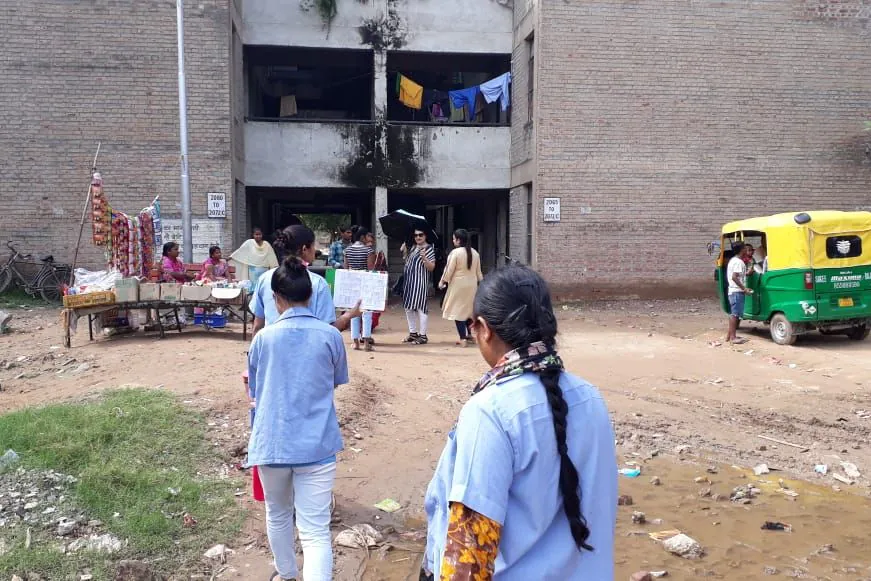
Our medical team already visits Dhanas each month. The pilot has begun with field visits a couple of times a week, and it aims to make this work local and measurable. Once funding is secured, women from Dhanas will become Health Promoters, each with a mentor from Janta Colony. A baseline census, digital records and an independent endline survey will show what changes.
- A baseline census of each household
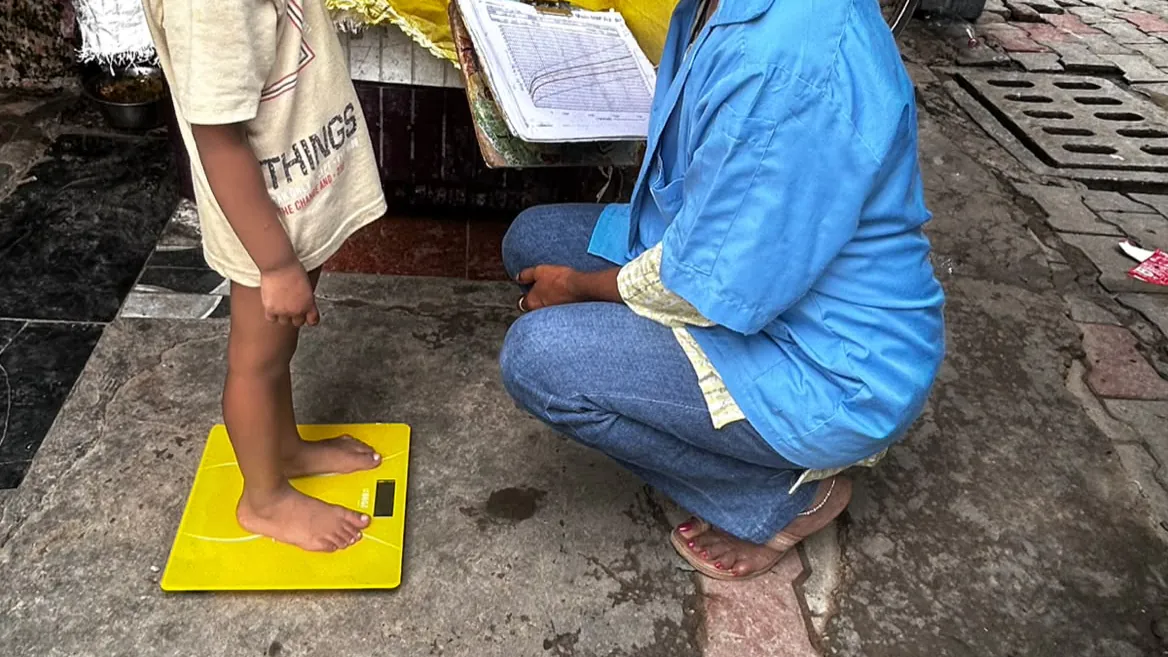
- Monthly weight checks with WHO standards
- Care before and after birth, and immunisation follow-up
- Referral to Anganwadi centres and government health services
“Our medical team already visits Dhanas each month.”
Where the pilot stands
The pilot has begun in part. We make field visits in Dhanas regularly, a couple of times a week. The full pilot has not started yet: it needs a local office and Health Promoters recruited from the colony. It will begin once funding is secured, and it also depends on the approvals it needs. The sections below describe the full pilot as it is designed.
Why Dhanas
Dhanas is a rehabilitation colony on the edge of Chandigarh. Families here face several health problems at once. Children and mothers do not eat enough, water is unsafe and sanitation poor, and few families know about immunisation and disease prevention. Illness that could be prevented, such as diarrhoea, anaemia and chest infections, is frequent. Children under five and pregnant women carry the greatest risk.
Government services exist in Chandigarh, but many households here do not use them. Families may not know their entitlements, may not trust the system or may not reach it easily. What is missing is a trusted neighbour who walks families to services that already exist.
That person is the Health Promoter: a woman from the colony, trained to visit households, weigh children and follow every pregnancy. Our Health Promoters already work in Dhanas, and the Child Activist Program (CAP) runs there too. The pilot sets out to make this work local, measurable and lasting. That matters for three reasons:
- Less preventable illness and death for families now.
- Less avoidable demand on public health facilities.
- A model that other rehabilitation colonies can copy, if the work succeeds in Dhanas as it did in Janta Colony.
The pilot area
Dhanas is laid out in blocks of flats with the same number of households each. The full pilot will cover some of the blocks, chosen at its start for need and readiness. The size of the pilot area below is a planning estimate: the baseline census of every household will confirm it, and our own register of Dhanas already gives a first count.
In numbers
| Measure | Estimate |
|---|---|
| Blocks in Dhanas | 40 |
| Households per block | 64 |
| Households in all of Dhanas | about 2,560 |
| Blocks covered by the pilot | 17 of 40 |
| Households in the pilot blocks | about 1,088 |
| People in the pilot area | about 10,000 |
| Children under 5 | about 600 |
| Pregnant and lactating women | about 200 at any time |
| Women aged 15–49 | about 2,200 |
| Health Promoters | 12 (6 new from Dhanas, 6 mentors from Janta Colony) |
| Health Promoters to people | about 1 : 833 |
Our Dhanas register already lists 9,742 people (August 2026). The pilot plan works with its own estimate for the pilot blocks, and the baseline census sets the final count.
The approach
The pilot is built on what we call a train-the-successor design. Experienced Health Promoters from Janta Colony do the work in Dhanas and, at the same time, teach women recruited from Dhanas, one mentor for each new Health Promoter. The mentors travel between the two colonies in a DIR vehicle. Step by step, the new Health Promoters take over, until Dhanas has its own team.
Each Health Promoter works with a committee in her block. The committee meets every month, hears what the weighing showed and decides on local action, such as a clean-up or a visit to a family that has missed a vaccine.
In the plan, a working day has a fixed shape. It begins with short classes for the Health Promoters on communication, basic physiology and nutrition, hygiene, ORS (oral rehydration solution), how diseases spread and immunisation. Then the team goes into the blocks. Dhanas has no space for supervised meals like NIPP, so nutrition care rests on weighing, supplements, counselling and referral.
Who does what
- New Health Promoters from Dhanas (full-time): the future permanent team.
- Experienced Health Promoters from Janta Colony (part-time): field work plus training, shadowing and mentoring.
- A senior supervisor and field coordinator: field oversight, digital records and reports, training, nutrition demonstrations and meetings.
- A junior doctor (part-time): classes for Health Promoters and clinical review and referral of children the team flags.
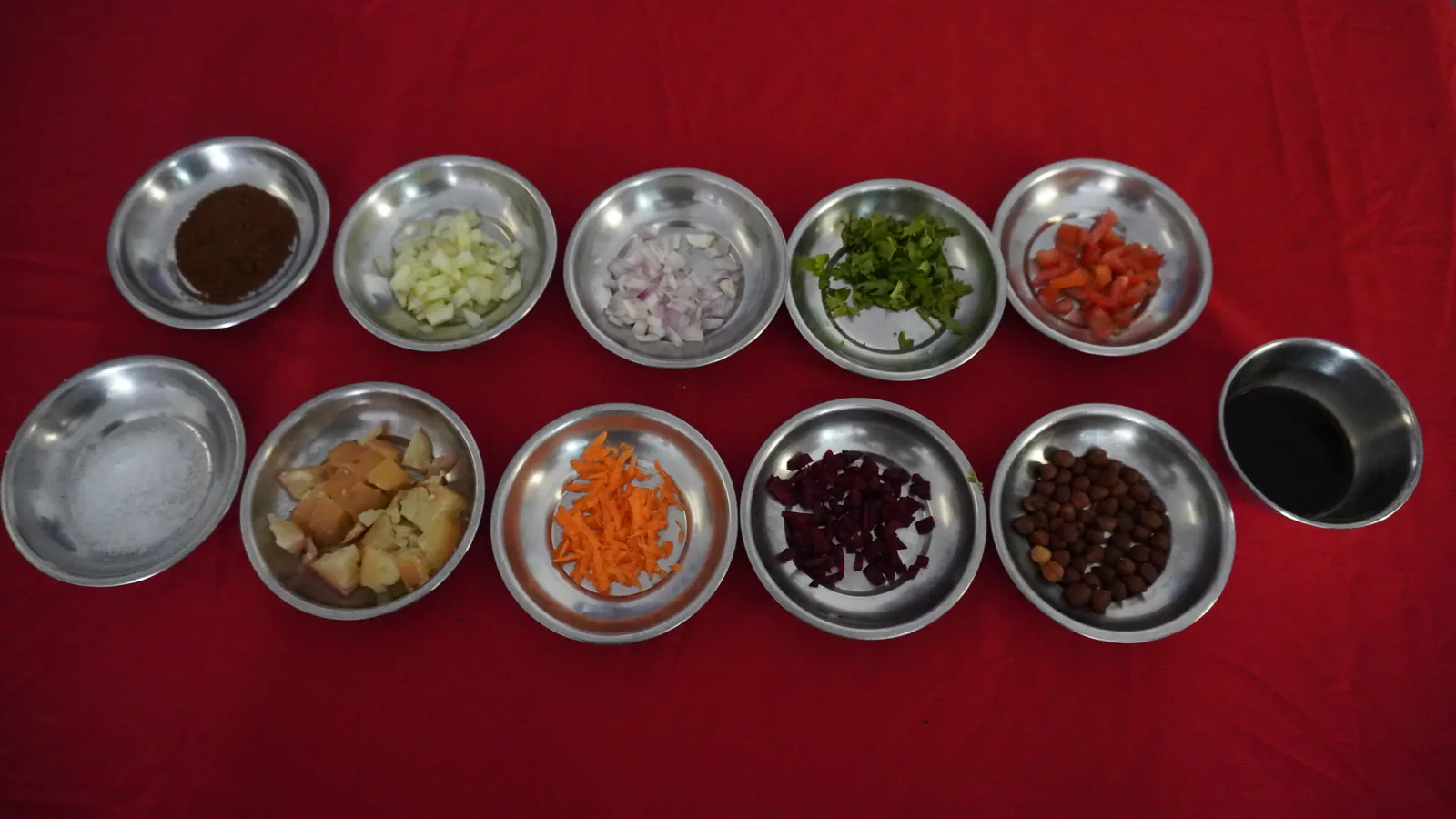
- A nutritionist: leads the nutrition work and the cooking demonstrations.
- A driver: takes the team to the field each day.
- A support staff member from Dhanas: looks after the field office.
- A part-time accountant: keeps the project books.
- The CEO (part-time): runs the pilot and answers to the board.
Three years, step by step
The plan divides the three years into phases, counted from the start of the full pilot. Each phase has milestones the board can check.
- Months 1–2Set up the field office, recruit the new Health Promoters from Dhanas, buy the equipment, start the digital records, count every household in a baseline census and survey, and agree the working procedures and the referral protocol.
- Months 3–12Daily classes and field work. Every child under five is weighed each month, immunisation and antenatal care are tracked, and block committees are formed.
- Months 13–24Full mentoring of the new Health Promoters, a mid-term review and closer links with government services. The new Health Promoters take lead roles.
- Months 25–34Consolidation and a step-by-step handover to the Dhanas Health Promoters and the block committees.
- Months 35–36An independent endline survey. The results are written up and shared.
What the Health Promoters do
Most of the pilot happens on doorsteps. A Health Promoter knows the households of her block and comes back every month. The plan asks the team for this work:
- Train the new Health Promoters in class and on the job, with a monthly refresher.
- Count every household in a baseline census and survey.
- Weigh every child under five each month, check weight for age and screen for wasting with MUAC (mid-upper-arm circumference) or weight for height; then counsel, supplement or refer, by severity.
- Give vitamin A and deworming tablets to children under five twice a year.
- Support every pregnancy: the recommended antenatal check-ups, iron-folic acid and calcium, the Td (tetanus-diphtheria) vaccine, birth in a health facility and the government maternity schemes.
- Follow every child under five against the national immunisation schedule, using government services.
- Promote safe water, ORS preparation, sanitation and clean-up drives.
- Hold monthly block meetings and demonstrations.
Nutrition care and referral
Nutrition care follows national guidance. All children aged 6–59 months get iron-folic acid on the Anemia Mukt Bharat schedule (the national anaemia programme), every second week. Children aged 9 months to 5 years get vitamin A twice a year, and children aged 12–59 months get a deworming tablet twice a year. Medicines come from a licensed pharmacy, in children’s doses set under the junior doctor’s oversight; where government stock is available, it is used first.
What happens next depends on the monthly weight. A child who is mildly or moderately underweight gets dietary counselling and, where needed, extra food, and the family is linked to the Anganwadi centre for its food and take-home rations. A child with moderate acute malnutrition gets energy-dense food, more counselling and closer follow-up. Pregnant women get iron-folic acid, calcium and advice on diet.
Severe acute malnutrition (SAM) is the most serious case. A child has SAM when weight for height is below −3 SD, when MUAC is below 11.5 cm, or when both feet are swollen with pitting oedema. As in all of DIR’s work, government facilities come first, and direct help is kept for exceptional cases. The pilot follows five steps for SAM and for emergencies:
- Identify. The Health Promoter looks for danger signs. In children: SAM, not feeding, drowsiness, fits or severe dehydration. In pregnancy: bleeding, very high blood pressure or obstructed labour.
- First response. She does what she is trained to do, for example ORS for dehydration, counsels the family and tells the senior supervisor and the junior doctor at once.
- Refer. By default, the case goes to the right government facility: the Nutrition Rehabilitation Centre, the urban primary health centre or a hospital. A Health Promoter goes with the family where needed.
- Help directly, only when needed. If referral is not possible in time and delay would cause harm, DIR gives direct help, such as emergency transport, food to bridge the gap or essential medicines.
- Record and follow up. Every referral and every direct intervention goes into the digital records and is followed until it is resolved.
Records and privacy
In the pilot, digital records are to replace the paper registers. The system takes over the household register and the monthly Health Promoter forms, and it runs on the project laptops and the Health Promoters’ phones. It covers the register, the monthly weighing, immunisation and antenatal tracking, and referrals. The aim is better data and less copying by hand.
The system also does the arithmetic. It works out each child’s weight-for-age and related z-scores on WHO (World Health Organization) standards, the coverage of immunisation and antenatal care, and the numerators and denominators of each indicator.
These records hold health data on children and pregnant women, so the system is designed for the Digital Personal Data Protection Act, 2023. The rules are simple to state:
- Families give informed consent when they are enrolled.
- Only the data the work needs are collected.
- Each person sees only what their role requires.
- Data are encrypted and stored securely.
- Only aggregate, non-identifiable data are published; individual health records are never shared.
What we measure
The pilot measures three headline indicators at the baseline and at the end of the third year. We will publish the results after the independent endline survey.
- Underweight children under five
- Full immunisation at 12 to 23 months
- Births in a health facility
How results are measured
Measurement frames the pilot. A baseline at the start sets where each indicator begins, a mid-term review checks progress, and an independent endline survey at the end of the third year measures the change. Children’s growth is measured on WHO child-growth standards: a child is underweight when weight for age is below −2 SD, a measure called the weight-for-age z-score (WAZ). Full immunisation is counted among children aged 12–23 months, on the national schedule.
The headline indicators shown above answer one question: did children and mothers become healthier? Process indicators answer a second: is the work being done well, month by month?
- Share of children under five weighed each month
- SAM and moderate malnutrition cases found, referred and recovered
- Pregnant women registered in the first trimester of pregnancy
- Antenatal check-ups completed per woman
- How well iron-folic acid is taken
- Coverage of the vitamin A and deworming rounds
- Caregivers who can prepare and use ORS
- Children who drop out of the immunisation schedule
- Block committees that work
- Health Promoters who leave
In the plan, reports move up every month. Each Health Promoter reports through the digital records to the senior supervisor, the supervisor reports to the CEO, and quarterly reports go to the board. That way a problem in one block reaches the people who can fix it within weeks.
Risks and how we handle them
A pilot is a test, and a test can fail for reasons that have nothing to do with the model. These are the main risks, each with a plan.
| Risk | How the pilot handles it |
|---|---|
| Health Promoters leave | Recruit women from Dhanas itself, mentor them closely and support them to stay. |
| Medicines are short or of poor quality | Buy through a licensed pharmacy, store medicines properly and keep batch and expiry records; use government stock first. |
| Health data are exposed | Digital records designed for the Digital Personal Data Protection Act, 2023: consent, minimal data, role-based access, encryption. |
| The start is delayed | Plan the preparatory phase so it can begin as soon as funding and the needed approvals are in place. |
| Families do not use government services | Health Promoters from the colony explain entitlements, build trust and go with families to the facility. |
What lasts after the pilot
The pilot does not test an untried idea. It takes a model built over many years in Janta Colony, and already at work in Dhanas, and asks whether a local team trained by its peers can carry it on. It is measured for exactly that reason: to confirm that the model travels. What is meant to last is not a clinic. It is changed health habits, and local people who can keep them going.
Four things are meant to make the work last:
- A permanent team of Health Promoters from Dhanas, trained during the pilot and living in the blocks they serve.
- Block health committees that take on more of the health work themselves.
- Families linked to the government services they are entitled to, such as ICDS, the National Health Mission, immunisation, the maternity scheme and Anemia Mukt Bharat, so essential care rests on the public system.
- Step-by-step embedding of the Health Promoter role in the government ASHA structure, so the team has a lasting home.
DIR stays involved throughout as the developer of the model and a source of technical support. Growth would come in three stages, and each stage starts only if the evidence from the one before supports it:
- PilotSet up, measure and refine the model in the pilot blocks of Dhanas, and record what must change to use it beyond Janta Colony. The independent endline survey shows whether the headline indicators are met.
- All of DhanasIf the pilot meets its indicators, extend the model to the rest of Dhanas. The trained Dhanas Health Promoters mentor the new recruits, using the same train-the-successor method.
- GovernmentIf the full Dhanas programme succeeds, offer the model to government, with its evidence, training, digital tools and protocols, for other rehabilitation colonies and urban settlements, delivered through the existing ASHA workers.
For government partners
The pilot links families to the services of government: Anganwadi centres, the National Health Mission, immunisation and Anemia Mukt Bharat. If the pilot meets its indicators, we want to design a programme with government for similar colonies.
- See a Health Promoter at work in Dhanas
- Join the mid-term review as an observer
- Tell us what evidence you need
How the pilot works with government services
The pilot does not build a parallel system. Its job is to connect families in Dhanas to services that the government already runs. The Health Promoter role also maps onto the ASHA (Accredited Social Health Activist) structure, so growth can mean strengthening a public system rather than adding a new one. The table shows each link in the plan.
| Service | How the pilot links to it |
|---|---|
| ICDS (Integrated Child Development Services) and Anganwadi centres | Families of underweight children are linked to Anganwadi supplementary nutrition and take-home rations. |
| National Health Mission (NHM) | Care follows national programme guidance; families are linked to its services. |
| Universal Immunization Programme | Every child under five is tracked against its schedule and vaccinated through government services; pregnant women get the Td vaccine. |
| Anemia Mukt Bharat | Iron-folic acid for children aged 6–59 months on its schedule, every second week; iron-folic acid for pregnant women. |
| Vitamin A programme and National Deworming Day | Rounds twice a year for children under five, on the national doses; government stock is used first where available. |
| Janani Suraksha Yojana (JSY) and Janani Shishu Suraksha Karyakram (JSSK) | Pregnant women are encouraged to give birth in a health facility and are linked to these maternity schemes. |
| Nutrition Rehabilitation Centre | Children with SAM are referred there. |
| Urban primary health centre and hospitals | Emergencies in children and in pregnancy are referred there first. |
| ASHA structure | The Health Promoter role is planned to be embedded in it step by step, and the model offered through ASHA workers if the evidence supports it. |
We would like officers to see this work for themselves. You can walk with a Health Promoter during a monthly weighing in Dhanas, join the mid-term review, or tell us what evidence your department needs before it can adopt a model like this.
Programme updates
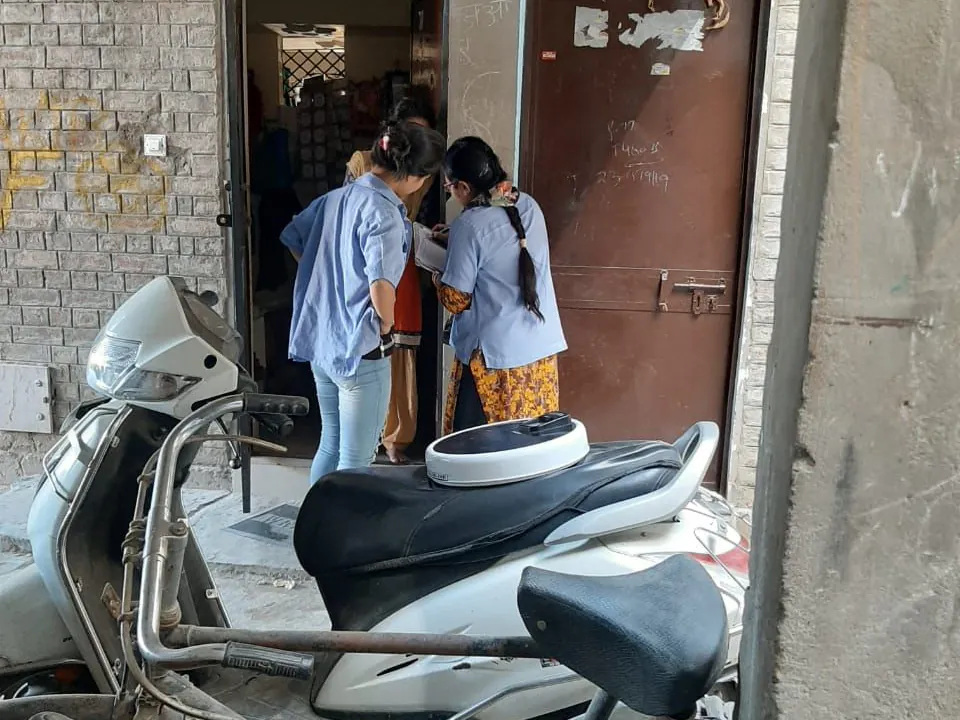
A survey visit at a door
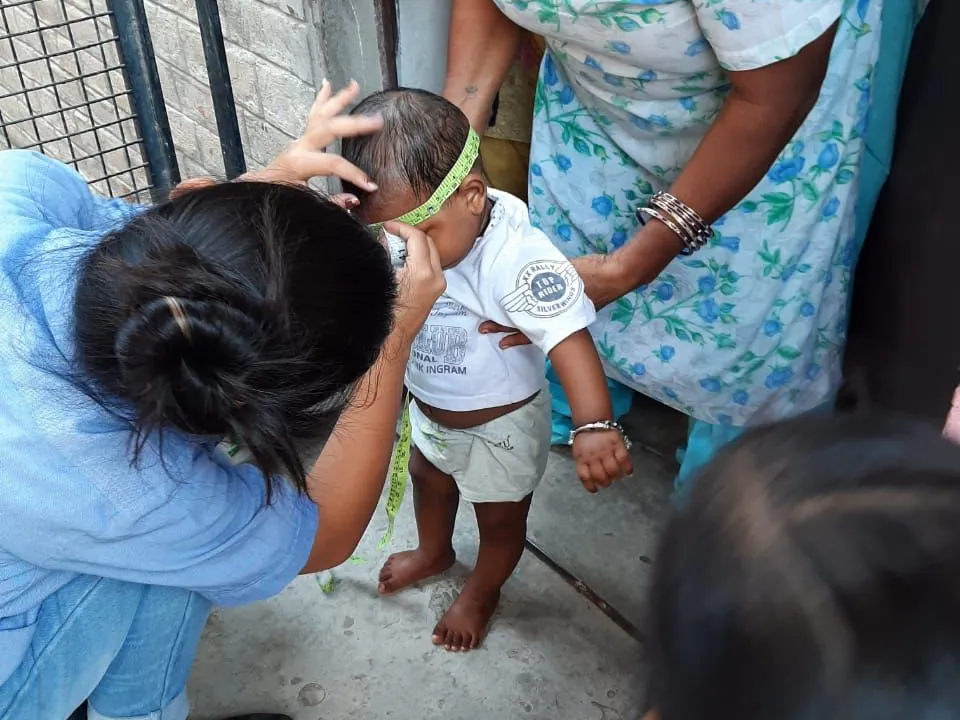
Measuring a baby
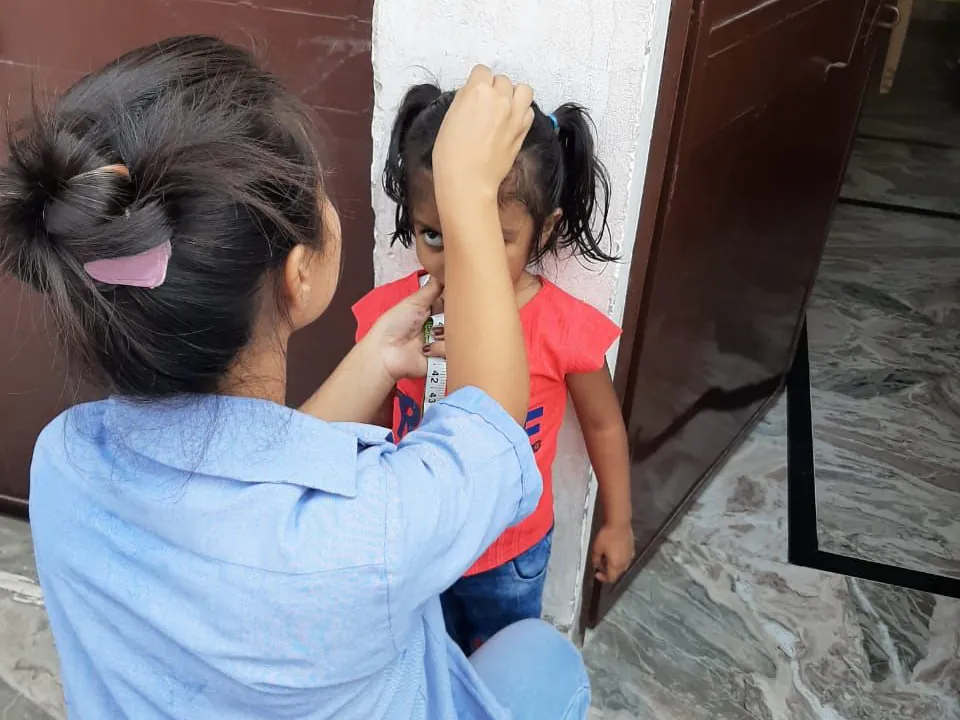
Measuring a child’s height
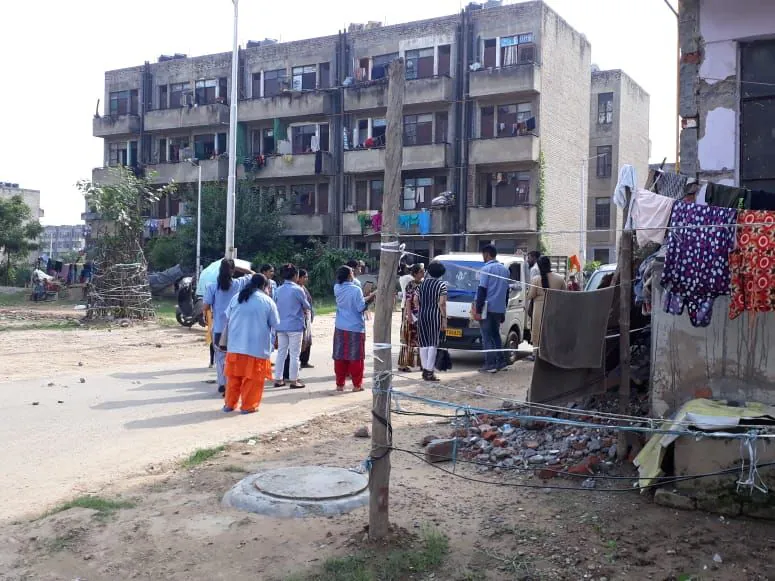
Health Promoters in Dhanas
Donate
UPI or bank transfer, for donors in India.
DonateVolunteer
Students and professionals join our team.
Join the teamContact
Visit us in Nayagaon, Monday to Friday.
Get in touch